A restaurant website has one job. Somebody is standing on a sidewalk, or sitting on a couch at 7 PM, deciding where to eat. Your site has about eight seconds to make that decision easy.
Almost everything else people put on restaurant sites gets in the way of that. Here is what actually earns its place, in the order a hungry person needs it.
The four things people came for
Open any restaurant site on your phone and time how long it takes to find these:
- The menu, with prices
- Are you open right now
- Where you are and how to get there
- How to order or reserve
If any of those takes more than a couple of taps, you are losing customers to the place down the block whose site is worse-looking but easier.
Everything else, the story of the founding, the chef’s philosophy, the gallery of the dining room at golden hour, comes after. Not because it does not matter, but because nobody reads it before they have decided to come.
The menu is the website
This is the part restaurants get wrong most often, and it is worth being blunt about.
Do not put your menu in a PDF. A PDF on a phone opens as a tiny document that people have to pinch and drag around. Google cannot read the dishes properly, so you do not show up when somebody searches for the thing you are known for. And every time a price changes, somebody has to redesign a document.
Do not put your menu in a photo either. Same problem, worse. A photo of a printed menu is unreadable on a phone and invisible to search.
The menu should be text on the page, organized by section, with prices, that you can update yourself in a minute when the price of a dish changes. That is not a technical luxury. It is the difference between a site that works and a brochure that happens to be online.
If you serve a dish people specifically search for, and in the Bronx that is often something like mofongo, sancocho or pernil, having those words as real text on your page is how you turn up in that search at all.
Photos: fewer and honest
Two rules that save a lot of money and a lot of disappointment.
Fewer, better. Six good photographs beat forty mediocre ones. Forty photos also make the page slow, which costs you more customers than the photos win.
Honest. If the picture shows a dish that looks nothing like what arrives at the table, you have created a complaint, not a sale. If you use illustrations or stock imagery because real photography is not in the budget yet, say so on the page. Customers forgive a placeholder. They do not forgive feeling misled.
Online ordering, and the arithmetic nobody does
Delivery apps typically take somewhere between 15% and 30% of each order, depending on the plan and the services you use. On a $40 order that can be $6 to $12 off the top.
That does not make them a bad idea. They bring you customers who would never have found you, and for a new restaurant that reach is worth paying for.
What it does mean is that the customer who already knows you and already decided to order from you should not be arriving through an app. Every order you take directly is the same food at meaningfully better margin.
So the practical setup for most Bronx restaurants is both: keep the apps for discovery, and make ordering directly from your own site obvious enough that regulars use it. Even a simple order form or a WhatsApp button beats sending a loyal customer through a commission.
Your Google listing matters more than your website
Worth saying plainly, even though we build websites.
When somebody searches “dominican restaurant near me,” Google shows a map with three businesses before it shows any website at all. Which three appear is decided by your Google Business Profile: your category, your reviews, your hours, your photos. Not by your site.
So if you have limited time and money, the order is:
- Claim and complete your Google Business Profile
- Get reviews, consistently, forever
- Then build the website
The website’s job is to convert the person who already found you and is deciding. That is a real job and it is worth doing well. It is just not the job of getting found.
The two do connect: your site should link to your listing, your listing should link to your site, and the name, address and phone number must be character-for-character identical in both places. Inconsistency there quietly hurts your ranking, and almost nobody checks it.
Phone-first, and it is not close
Most restaurant traffic is on a phone, and much of it is on a phone with one bar of signal on a street corner.
That means the phone number should be a button that dials when tapped, not text somebody has to copy. The address should open the map app. Hours should show today, not a table of all seven days that you have to scan.
And the site should load fast on a bad connection, which is mostly about not shipping forty photographs and a slideshow.
Spanish, if that is who eats there
In much of the Bronx, a site that exists only in English is turning away part of the neighborhood.
Real bilingual means both versions are properly built and switchable, not a browser translate widget that mangles your dish names. Your menu especially: nobody wants to see their grandmother’s food auto-translated into something strange.
If most of your customers speak Spanish, consider which language should be the default, not just which one is available.
What to skip
- The intro animation. It delays the menu, which is the only thing anyone wants.
- Background music. Please.
- A blog, unless somebody is genuinely going to write it. An abandoned blog with three posts from 2024 makes the business look closed.
- A reservation system, if you do not take reservations. A button that goes nowhere costs trust.
- Forty gallery photos. See above.
What it costs
For a restaurant, most of the work is one well-built page or a small handful: the menu, the location and hours, a way to order, and enough about you to make somebody want to come.
Our fixed prices are $450 for a single page and $800 for four pages, one time, for the build. After that, hosting is $120 a year and the domain $20, and that is the whole recurring cost. What you will not get from us is a monthly agency fee for maintaining a site that is already finished.
A menu you can update yourself is included, because a menu you have to call somebody to change is a menu that goes out of date.
A real one
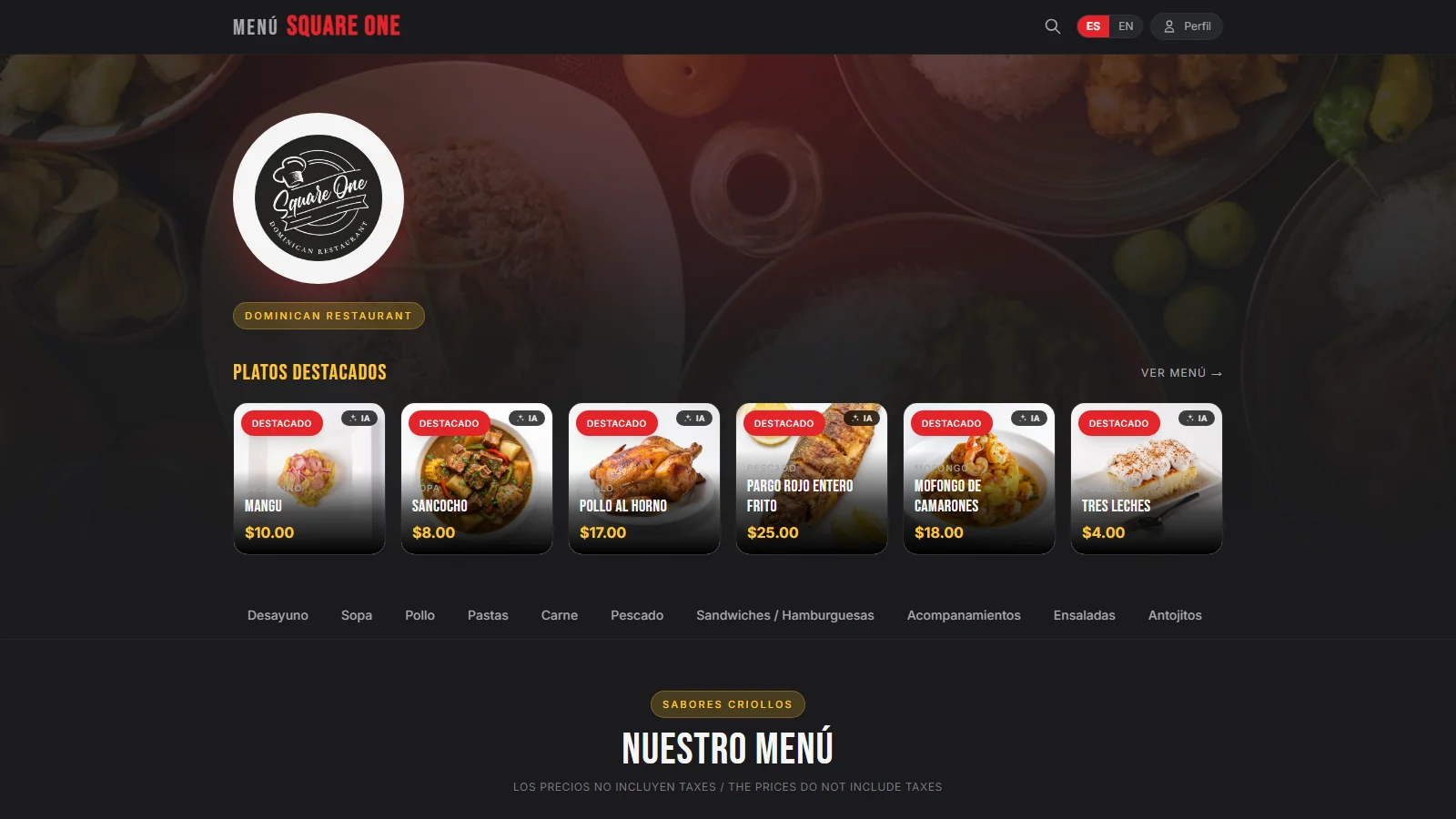
Square One is a Dominican restaurant menu we built: dishes as real text with prices, organized by section, in Spanish and English, built for the phone first. That is the shape most restaurants need. You can open it and judge it yourself, which is the point.
If you want to talk about yours, tell us what you need and we will come back with a plan and a number.
And if you are still deciding whether you need a site at all when you already have Instagram, that comparison is here.